
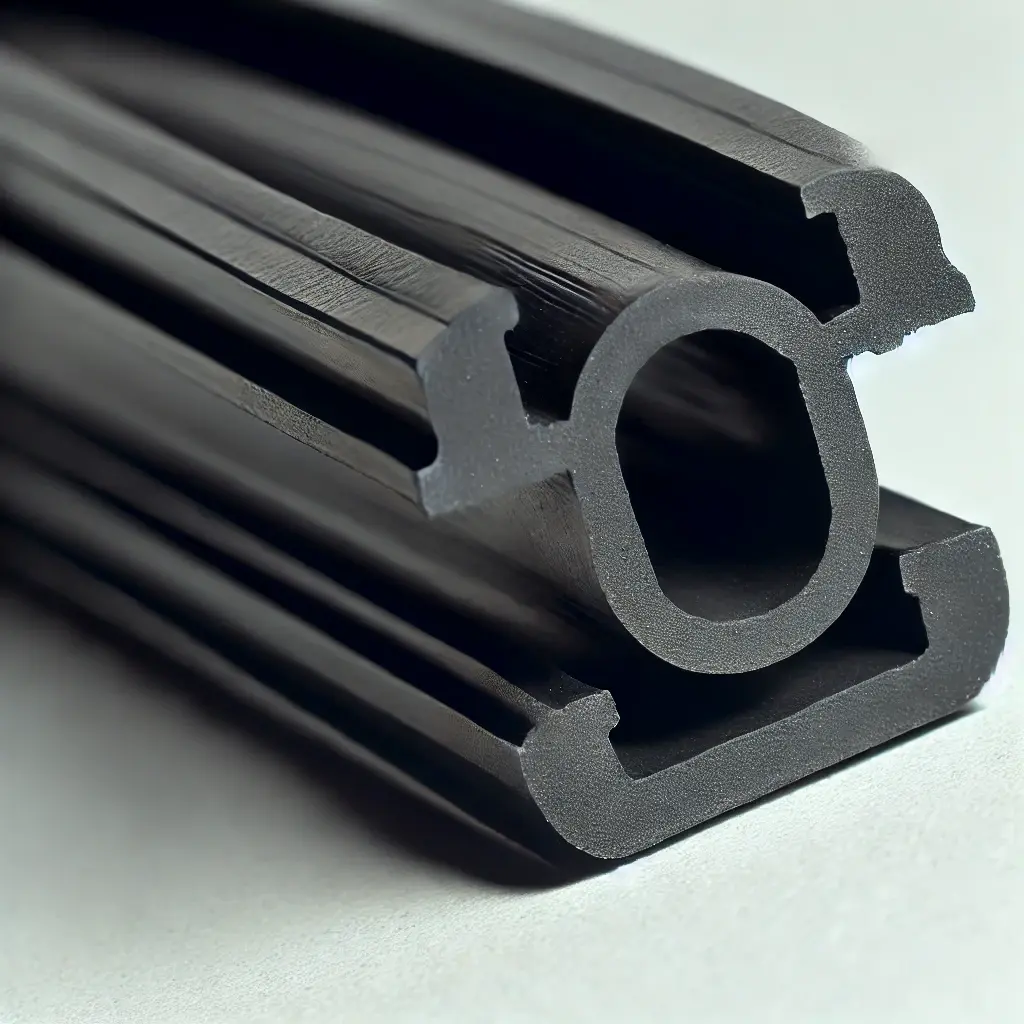
Hollow or solid fender strips: technical considerations for your choice
The choice between a hollow or solid rubber fender strip seems simple, but in practice it depends heavily on energy absorption, fitting method and structural dynamics. With many years of experience in extrusion and custom rubber profiles, DG Rubber Profiles knows that every application calls for a specific balance between flexibility and strength.
Energy absorption and deformation
A rubber fender strip acts as an energy-absorbing element. The hollow version works like a spring: the air chambers in the profile provide controlled deformation, so that shocks are absorbed gradually.
With solid profiles, by contrast, the energy is absorbed by the density of the material. The rule here is: less deformation, but a higher peak load.
Rule of thumb:
- Repeated contact → hollow profile (spreads energy over time)
- Occasional heavy contact → solid profile (absorbs energy directly)
Dynamics of the construction
The stiffness of the substructure determines how the profile behaves:
- Flexible constructions (such as pontoons or movable jetties) call for hollow profiles that can move with them without coming loose.
- Rigid constructions (such as concrete or steel) need structural resistance, and solid profiles perform better here.
The wrong combination can lead to excessive wear or even cracking of the profile or surface.
Would you first like to know which profile shape (D, U, B, L or custom) suits your application? Then also read our page on types of rubber fender strips
Shape memory and the influence of temperature
Rubber has what is known as shape memory. Hollow profiles recover their original shape more quickly after impact, but lose some flexibility at low temperatures.
Solid profiles stay dimensionally stable even in the cold, but can deform slightly and permanently under sustained pressure. EPDM is often chosen for outdoor applications with large temperature fluctuations.
Fixing and maintenance
| Application | Recommended fitting | Point of attention |
|---|---|---|
| Hollow profile | Adhesive, clamping profile or bolt through the air chamber | Avoid deforming the air channels during fitting |
| Solid profile | Bolts through the core or aluminium strip | Watch out for thermal expansion over long lengths |
The profiles also differ in maintenance:
- Hollow profiles are easier to replace
- Solid profiles often last longer but are harder to dismantle.
Practical examples
- Shipping: pontoons and tugs use hollow D profiles for shock absorption when mooring.
- Industry: loading docks or forklift zones call for solid fender strips for structural impact.
- Infrastructure: bridge sections or quay walls sometimes combine both profiles, hollow for flexibility and solid at corners for maximum protection.
Advice on custom profiles
At DG Rubber Profiles, we supply both standard and custom solutions. We can extrude profiles in various hardnesses (Shore 50–80A) and shapes (D, U, L, B). For heavy applications, internal reinforcement or a steel insert is possible.
Our tip: let us help you think about load direction, fitting method and ambient temperature. These three factors determine the right choice of profile in 90% of cases.
Summary
| Situation | Recommended profile | Reason |
|---|---|---|
| Movable or floating construction | Hollow | Flexible, damping, lightweight |
| Rigid construction with heavy impact | Solid | Strong, wear-resistant, structurally stable |
| Changing temperatures or outdoor use | Material choice tailored to the environment | Weather and UV resistance important |
Which solution suits your application?
Whether you work with pontoons, quays, trailers or machine frames, the right choice of profile always depends on the situation. That is why we offer technical advice + a wide range of standard and custom profiles.
Discover our range of rubber fender strips here and easily request a custom fender strip.