
A home gym needs a floor that absorbs the impact of weights, protects the subfloor and limits noise for the rest of the house. DG Rubber Profiles’ rubber floor tiles do that in a compact 540 × 540 mm size, 20 mm thick, which also fits in a garage, attic or utility room.
The tiles are laid loose on a level surface and are easy to expand later. Start with the zone under the rack and bench and add tiles as your home gym grows.
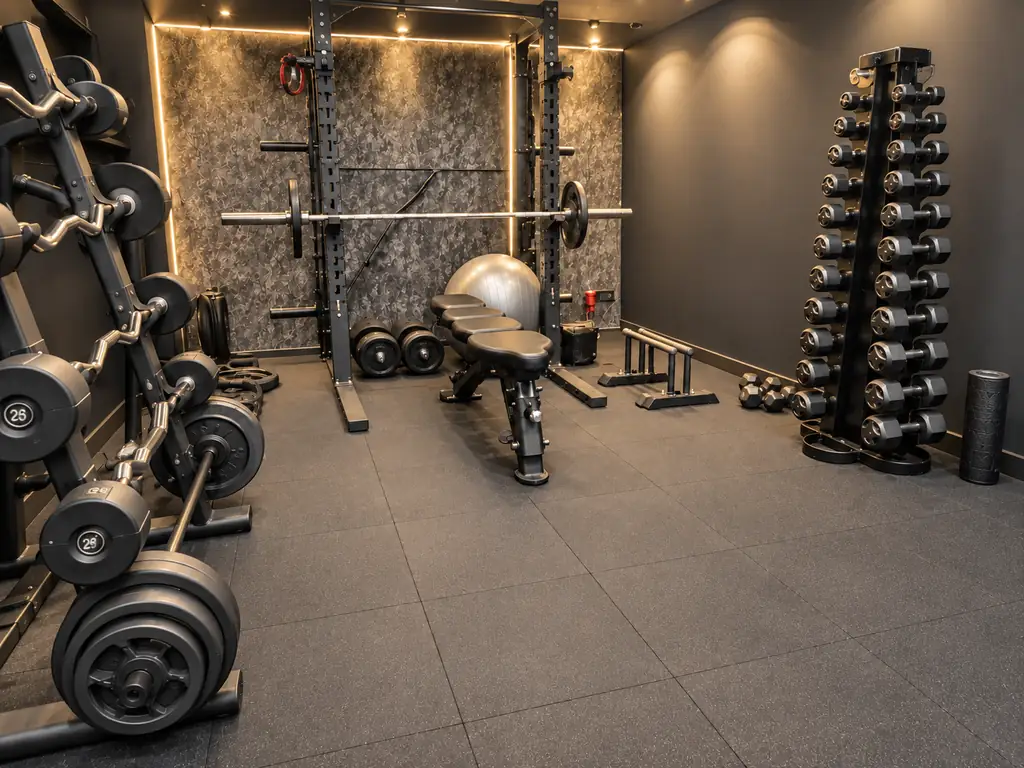
540 × 540 mm
Compact size, easy to handle and flexible to expand.
20 mm thick
Absorbs the impact of dumbbells and barbells and protects the floor.
Loose laying
No adhesive, no tools, lay it yourself in an afternoon.
Black
Shows dirt and wear the least and suits any interior.
Why a rubber floor in a home gym?
Floor protection
A falling dumbbell damages tiles, laminate or concrete. The 20 mm rubber layer absorbs the impact, so the floor below stays intact.
Less noise in the house
Rubber dampens the noise of weights coming down and vibrating machines, so less of your workout carries through to other rooms.
Grip during training
The granular structure of the rubber provides grip for squats, deadlifts and floor exercises, even with sweaty hands and feet.
Grows with your gym
Start small and expand. Tiles can simply be added when a rack, bench or cardio machine joins the setup.
Rubber tiles for garage, attic and utility room
Most home gyms are in a garage, attic or utility room. These are spaces with a hard, often cold floor that was not made for falling weights. Rubber tiles turn them into a training floor in an afternoon.
In a garage, the tiles lie directly on the concrete. In an attic or utility room, they protect the existing floor and dampen noise to the room below. The tiles are not glued down, so if you move house you can simply take the floor with you.
How many tiles do you need?
Calculate using the tile size of 540 × 540 mm. Some examples of common zones in a home gym:
Dumbbell zone
Approx. 1.6 × 1.6 m, 3 × 3 tiles: 9 tiles.
Rack with bench
Approx. 2.2 × 2.2 m, 4 × 4 tiles: 16 tiles.
Complete garage gym
Approx. 3.2 × 5.4 m, 6 × 10 tiles: 60 tiles.
Unsure about the number? Include the dimensions of the room with your enquiry and DG Rubber Profiles will calculate the number of tiles for you.
Laying rubber floor tiles in a home gym
- Measure the room. Measure the length and width of the room and decide which part will get rubber: the whole floor or just the zone under the rack, bench and weights. Use the tile size of 540 × 540 mm to work out how many tiles you need.
- Ensure a level surface. The tiles are laid loose and bear fully on the floor below. Concrete, tiles or a level wooden floor are suitable. Remove any loose parts and clean the floor.
- Lay the first row against a straight wall. Start in a corner and work row by row to the opposite side. Keep the joints straight for a calm floor appearance.
- Cut the last row to size. Where a whole tile does not fit, cut it to size with a sharp utility knife and a straight edge. The 20 mm rubber can be cut through with a few passes.
- Position the equipment. Put the rack, bench and weights back. The tiles stay in place through their own weight and the weight of the equipment.
Larger size for PT studios
Is your home gym becoming a PT studio, or do you train in a larger space? Then the 1,000 × 1,000 mm tile is an alternative. Fewer joints, a calmer floor appearance and available with a coloured EPDM top layer to mark zones.
Both sizes are 20 mm thick and made of the same SBR rubber, so you can combine them. All specifications can be found on the rubber gym flooring page. Training mainly with heavy free weights? Then read on under rubber flooring for free weights.
Why DG Rubber Profiles?
DG Rubber Profiles has specialised in rubber since 2014 and produces in Biddinghuizen. The gym tiles are supplied to gyms, PT studios and private individuals with a home gym, in quantities from a few tiles to a complete gym.
We respond to enquiries within 24 hours. Include the dimensions of the room and you will receive a proposal with the number of tiles you need.
Frequently asked questions about rubber floors for a home gym
What size of rubber tile is suitable for a home gym?
For a home gym, the 540 × 540 mm tile is the most practical. The size is easy to handle, fits in smaller rooms and can easily be expanded later with extra tiles.
Can I lay a rubber floor in a garage or attic?
Yes, as long as the surface is level and dry. The tiles are laid loose on concrete, tiles or a level wooden floor and do not need to be glued down.
How thick should a rubber floor for a home gym be?
DG Rubber Profiles’ gym tiles are 20 mm thick. That thickness absorbs the impact of dumbbells and a barbell and protects the floor below, including with free weights.
Can I cut the rubber tiles to size myself?
Yes. The rubber can be cut to size with a sharp utility knife and a straight edge for the last row along the wall.
Can I order more tiles later?
Yes. Because the tiles are laid loose, you can add tiles later when your home gym grows or you want to expand a zone.
Enquire about rubber tiles for your home gym
Send us the dimensions of the room or zone. DG Rubber Profiles will calculate the number of tiles and respond with a quote within 24 hours.