
New: DG outdoor tiles
Rubber playground tiles for safe play areas
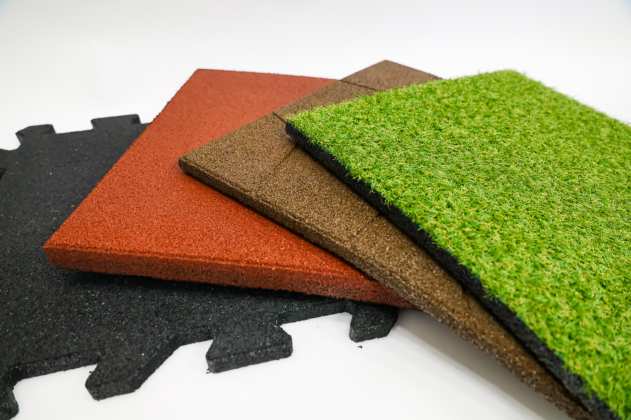
Rubber playground tiles form a shock-absorbing, water-permeable surface under and around play equipment. DG Rubber Profiles supplies them in various 500 × 500 mm versions: a 45 mm impact-absorbing tile, and a 30 mm artificial grass tile and puzzle tile. Made of recycled SBR rubber granulate bonded with PU adhesive.
Size
500 × 500 mm
Playground tile thickness
30 or 45 mm
Material
Recycled SBR rubber, PU-bonded
Versions
Black, red, brown or with artificial grass
Jump to: Versions · Thickness and fall height · Applications · Laying · FAQs
Why choose rubber playground tiles?
A play surface must cushion a fall, drain rainwater and stand up to wind and weather. Rubber tiles combine those requirements in one floor that you lay and replace tile by tile.
Impact-absorbing properties
The resilient rubber absorbs part of the impact in a fall. How much varies per tile: a thicker tile is generally intended for a greater fall height. The fall height a tile can handle is shown in the test data for that specific version.
Water-permeable construction
Rainwater drains away through the studs on the underside of the tile, so lay the tiles on a surface that drains water. On a sealed surface without a slope, water can remain standing.
Suitable for outdoor use
The tiles are resistant to weather and frost and can stay outdoors all year round. Regular sweeping and periodic checks keep the play surface in good condition.
Various versions
Plain rubber in black, red or brown, or a tile with an artificial grass top layer. This lets you choose the right combination of impact absorption, function and appearance for each location.
What playground tiles are there?
Three tiles from the outdoor range are most relevant for play areas. They differ in thickness, specified fall height and appearance.
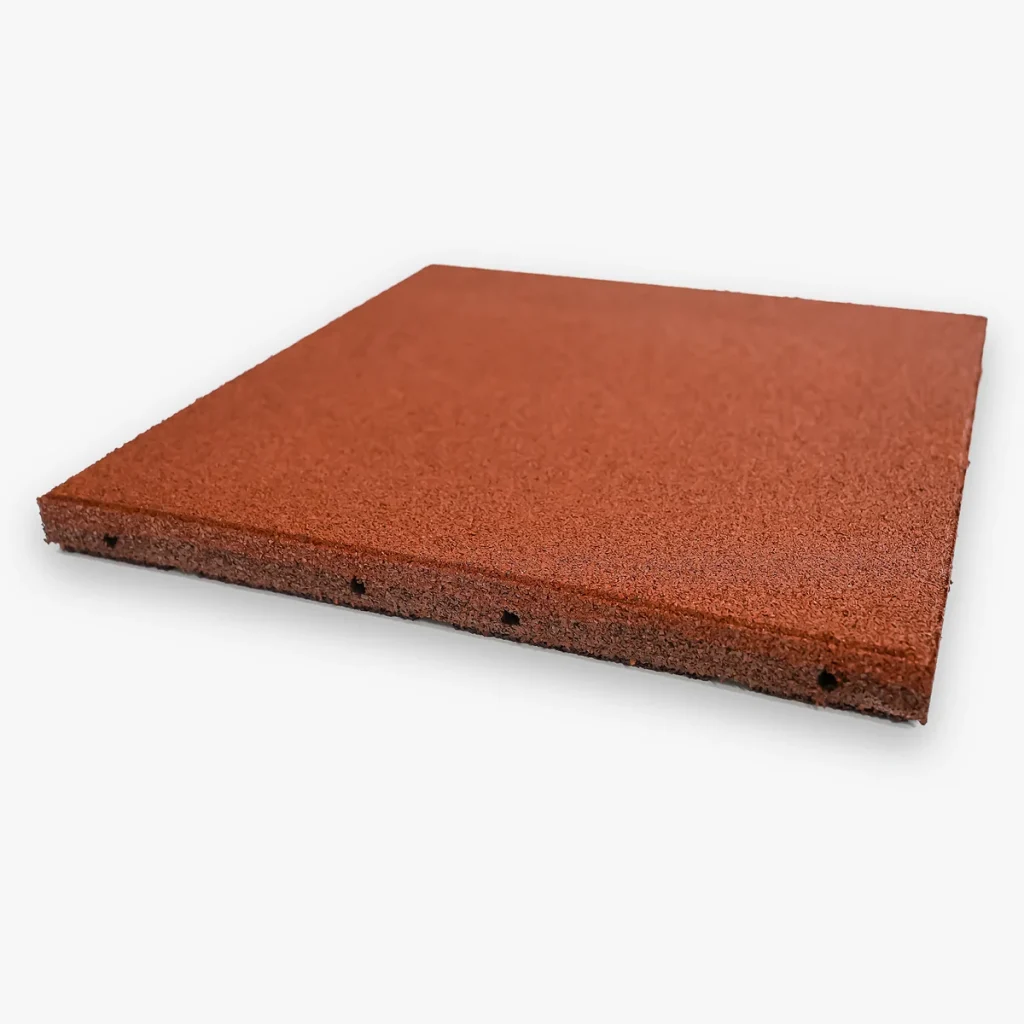
Under play equipment
Impact-absorbing rubber tile
500 × 500 × 45 mm
The thickest tile in the range, intended for the impact area under swings, slides and climbing frames.
Specified fall height: up to 1.5 m*
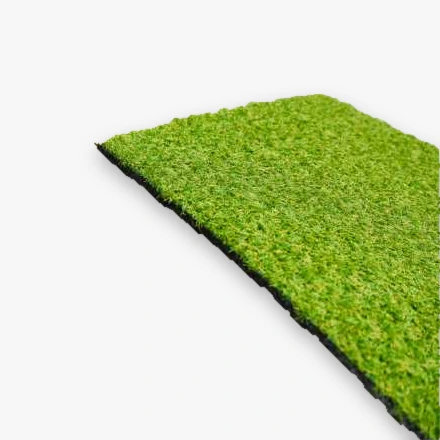
Green look
Artificial grass tile
500 × 500 × 30 mm
Rubber tile with an artificial grass top layer, for play areas where a green look is desired. Also used on roof terraces and balconies.
Specified fall height: up to 1.1 m*
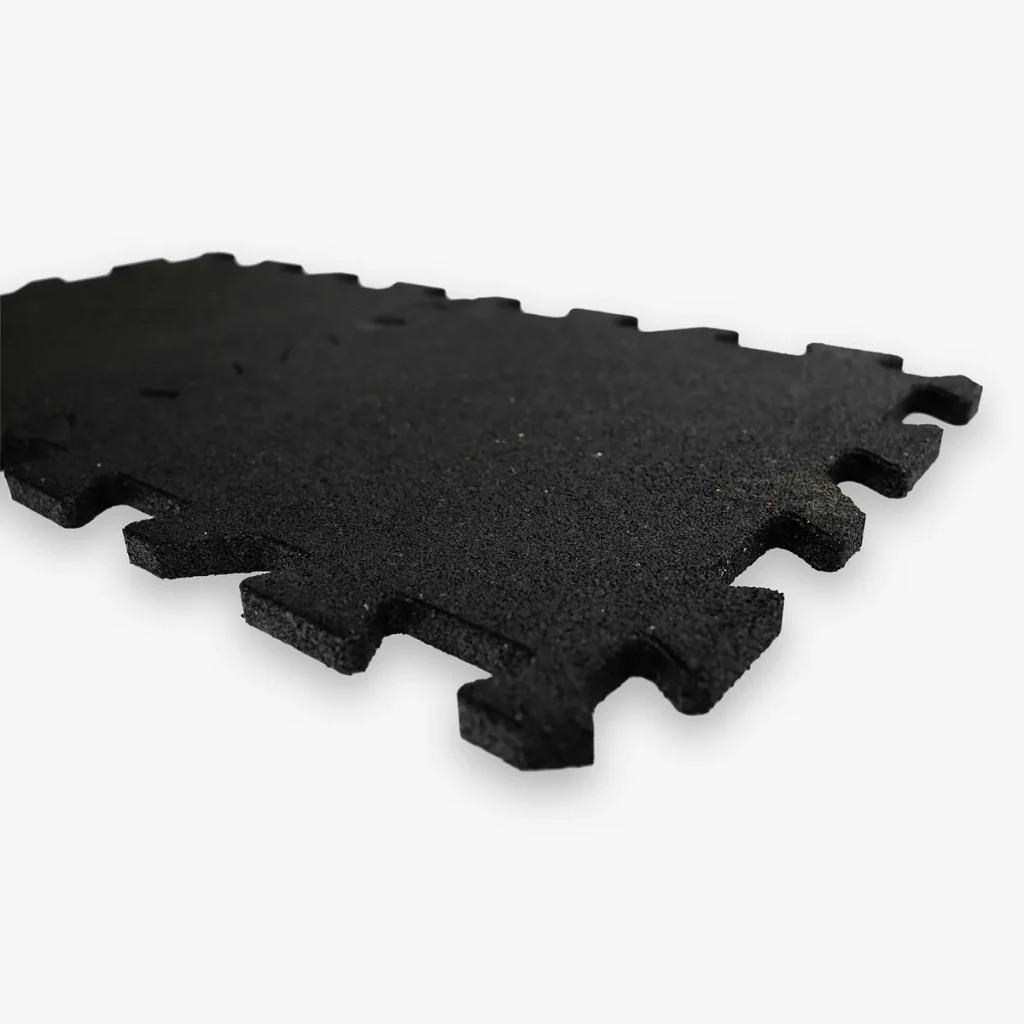
Play area and outdoor fitness
Puzzle tile
500 × 500 × 30 mm
Tile with a puzzle edge that interlocks with the adjacent tiles. Used for outdoor fitness, bootcamp and play areas.
Fall height: not specified, ask for advice
* Specified fall height according to the product specification. A critical fall height according to EN 1177 applies to the tested build-up of a floor. Ask for the test data of the chosen version with your enquiry.
Also available: outdoor tiles for terraces, paths and pastures
In addition to the playground tiles, the range includes tiles for other outdoor applications. No fall height is specified for these tiles. If you are looking for a surface under play equipment, choose one of the three playground tiles above.
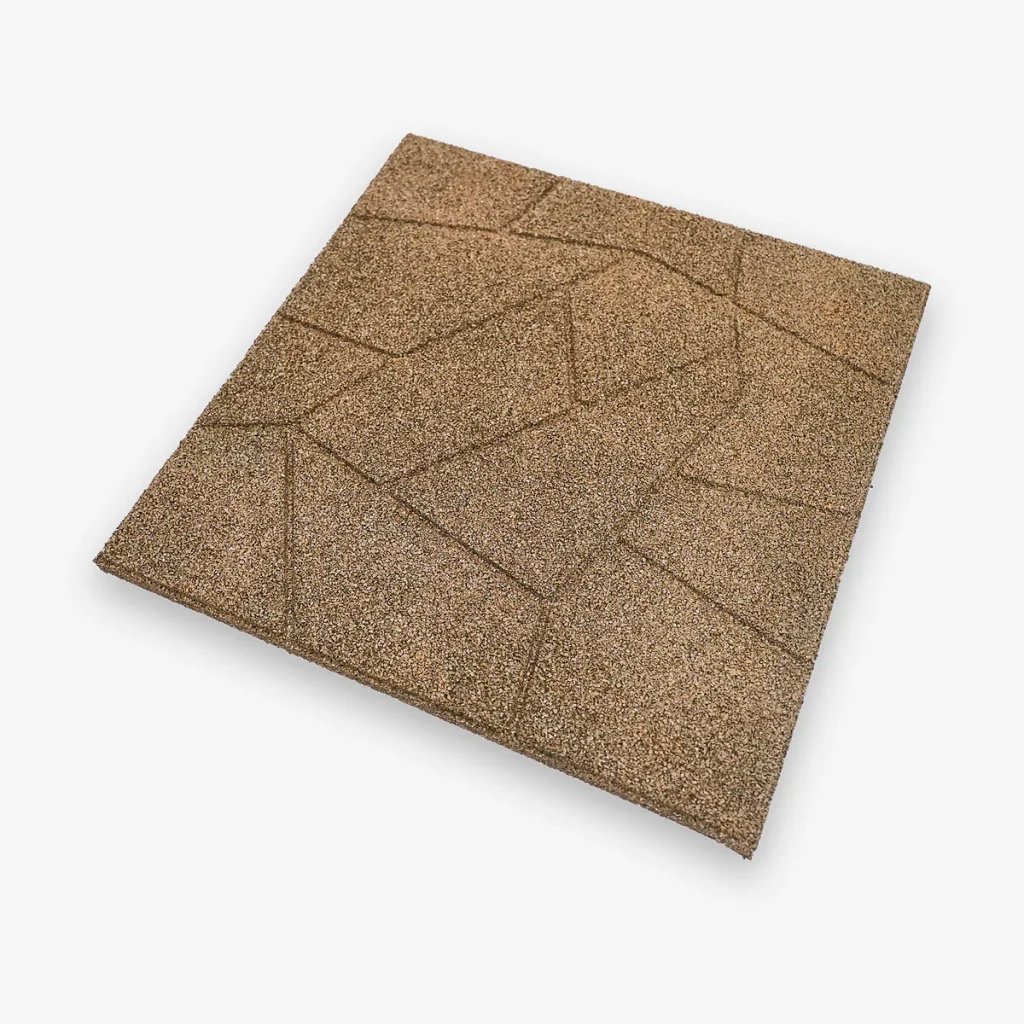
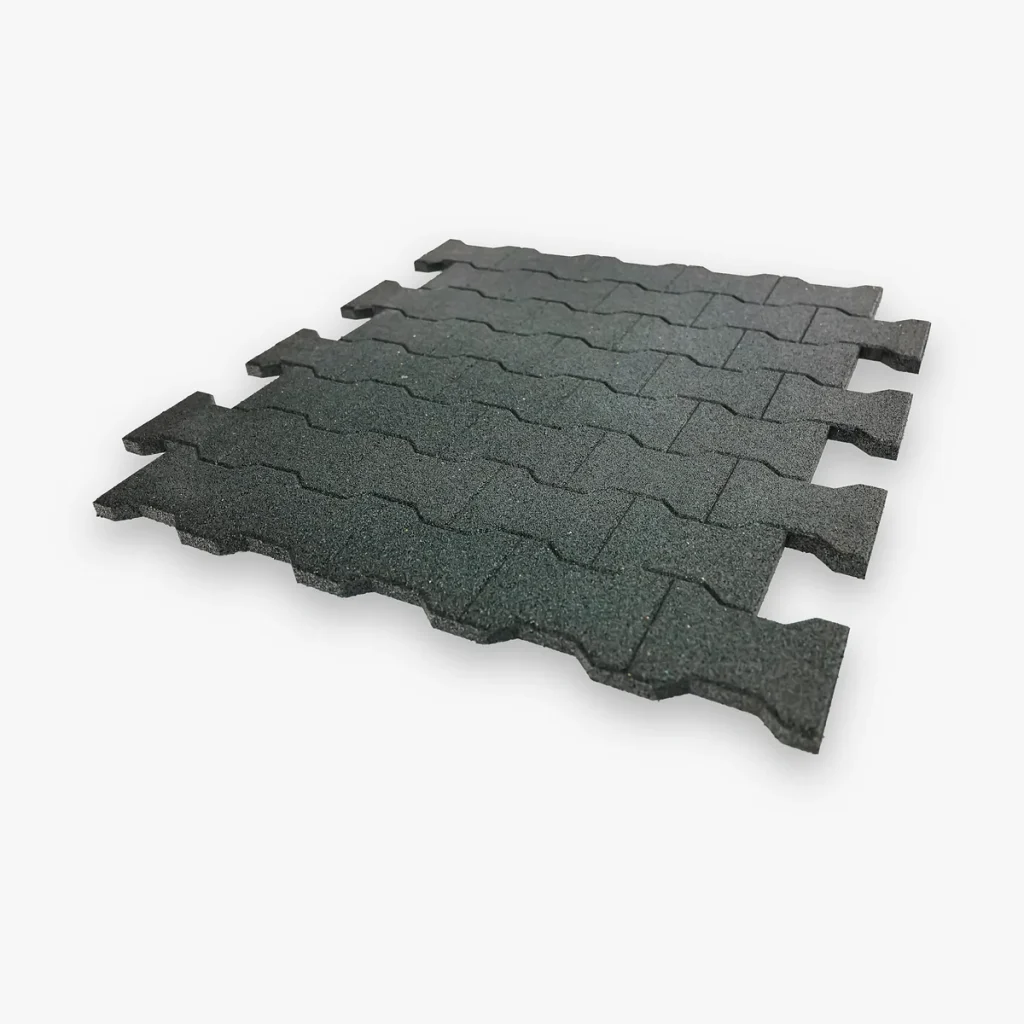
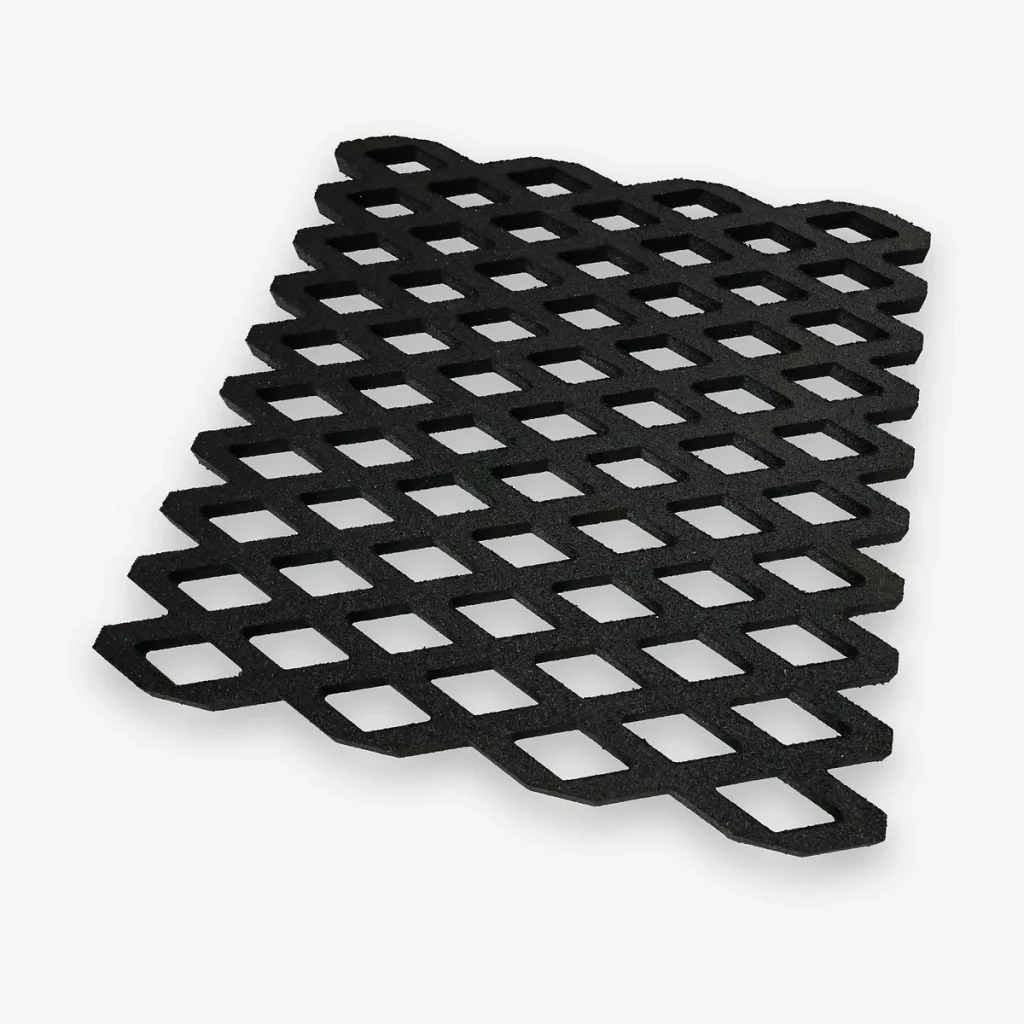
- Stone-pattern tile (500 × 500 × 30 mm): terraces and garden paths with a natural look
- Paver tile (500 × 500 × 30 mm): paths, walking routes and animal enclosures
- Grass protection mat (1,500 × 1,000 × 23 mm): footpaths and pastures where the grass grows through
What thickness of rubber tile do you need?
The thickness required depends on the fall height of the play equipment. The higher a child can fall, the more shock absorption the surface must provide, which generally calls for a thicker tile. But thickness alone does not say enough: what counts is the tested impact absorption of the specific tile, in the build-up in which it is laid.
Critical fall height and free fall height
Two terms are used for play surfaces that are often confused:
- Free fall height: the greatest height from which a child can fall from a piece of play equipment. This is a property of the equipment, determined according to EN 1176-1.
- Critical fall height: the greatest fall height for which a surface still provides sufficient shock absorption. It is measured using the test method in EN 1177.
A surface suits a piece of equipment when the critical fall height is at least equal to the free fall height. That critical fall height applies to the tested build-up: tile, connection and base together. A different base or laying method can affect the result.
Playground tiles compared
| Version | Dimensions | Specified fall height* | Application |
|---|---|---|---|
| Impact-absorbing rubber tile | 500 × 500 × 45 mm | up to 1.5 m | Under swings, slides and climbing frames |
| Artificial grass tile | 500 × 500 × 30 mm | up to 1.1 m | Play areas with a green look |
| Puzzle tile | 500 × 500 × 30 mm | not specified | Outdoor fitness, bootcamp and play areas |
Unsure which tile fits?
Mention the type of play equipment and the free fall height in your enquiry. We will then advise which tile fits and what product data goes with it.
In the Netherlands, play equipment on public and semi-public land, such as playgrounds and schoolyards, is subject to the requirements of the Dutch Commodities Act Decree on attractions and play equipment 2023 (Warenwetbesluit attractie- en speeltoestellen); outside the Netherlands, local regulations apply. The operator is responsible for the safety of the equipment and the surface.
Rubber playground tiles for various play areas
Use varies by location, and so does the choice of tile. An overview of the most common applications.
Schoolyards
Intensive use by large groups of children. Impact-absorbing tiles under climbing equipment, artificial grass tiles for a green play zone. In the Netherlands, schoolyards count as semi-public land under the Dutch Commodities Act Decree on attractions and play equipment.
Public playgrounds
For municipalities and operators, what counts is a surface that suits the free fall height of each piece of equipment and is easy to check and repair. Tiles laid loose can be replaced individually.
Play areas at childcare centres
Daycare centres and after-school clubs often have lower equipment and an outdoor space that also serves as a place to spend time. The artificial grass tile suits a green design, provided the fall height allows it.
Holiday parks and campsites
Playgrounds at holiday parks, campsites and hospitality venues are outdoors all year round. The tiles are resistant to weather and frost and available in various colours, so they blend with their surroundings.
Private play areas
Under a swing or play equipment in the garden too, the fall height is the starting point for your choice. Equipment on private land does not fall under the Dutch Commodities Act Decree on attractions and play equipment, but the same logic of fall height and surface helps you make a responsible choice.
Under swings, slides and climbing frames
Here it is the impact area that counts. Choose a tile whose tested critical fall height suits the free fall height of the equipment, and lay the tiles throughout the entire impact area specified by the equipment manufacturer.
How do you lay rubber playground tiles?
The outdoor tiles can be laid loose on a level, stable and water-permeable surface. The quality of that surface helps determine how the floor performs, both in drainage and in impact absorption.
- Assess the surface. Is it load-bearing and level, and does it drain water?
- Create a level, stable base. Unevenness will show through in the floor and can cause raised edges.
- Check the drainage. On a sealed surface without a slope, water will remain under the tiles.
- Follow the laying instructions for the chosen tile. Under play equipment, the build-up must match the tested configuration.
- Finish edges and joints safely, so that no open joints or trip edges are created.
- Inspect and maintain the floor. Regularly check for loose or damaged tiles and replace them individually.
For product-specific laying instructions, such as the build-up of the base and the edge finishing, contact DG Rubber Profiles.
Playground tiles made of recycled SBR rubber
The tiles are made of recycled SBR rubber granulate. SBR (styrene-butadiene rubber) is a type of synthetic rubber used in car tyres, among other things. For these tiles, the rubber is ground into granules and reused.
A PU (polyurethane) adhesive binds the granules into a solid tile. That bond gives the tile its shape and cohesion. The result is a resilient tile that dampens shocks and is resistant to weather and frost.
DG Rubber Profiles uses the same PU-bonded SBR rubber for rubber gym flooring in gyms and home gyms and for rubber stable tiles in the equestrian sector. Those tiles are intended for indoor and stable use; the playground tiles on this page were developed for outdoor play areas.
Want to know more about the differences between types of rubber? Read EPDM, neoprene or SBR: which rubber should you choose? in the knowledge base.
Why enquire about playground tiles at DG Rubber Profiles?
DG Rubber Profiles has been producing rubber profiles and custom rubber products from Biddinghuizen since 2014. We put that knowledge of rubber to work in choosing the right outdoor tile.
- Advice based on your application and the fall height of the play equipment
- Three playground tiles and additional outdoor tiles from one range
- Custom size, thickness, colour or shape on request
- Personal contact by phone or email, on working days from 8.30 to 17.00 CET
Enquire about playground tiles
Three steps to suitable advice or a quote.
Step 1
Describe the application
Where will the tiles be laid? Think of a schoolyard, a public playground or a garden, and the type of play equipment.
Step 2
Send us the dimensions and requirements
For example, the area, the desired version and colour, the free fall height of the equipment and the current surface.
Step 3
Receive advice or a quote
DG Rubber Profiles will assess your enquiry and advise on the options that suit your application.
Frequently asked questions about rubber playground tiles
What are rubber playground tiles?
Rubber playground tiles are tiles made of bonded rubber granulate that are laid as a shock-absorbing surface under and around play equipment. DG Rubber Profiles’ tiles are made of recycled SBR rubber bonded with PU adhesive and measure 500 × 500 mm. They are water-permeable and resistant to weather and frost.
Which rubber tiles are suitable for a playground?
The impact-absorbing rubber tile (45 mm) and the artificial grass tile (30 mm) are intended for play areas; a fall height is specified for both. The puzzle tile (30 mm) is also used in play areas and for outdoor fitness, but no fall height is specified for it. Which tile is suitable depends on the free fall height of the play equipment and the tested impact absorption of the tile.
What thickness of rubber playground tile do I need?
That depends on the free fall height of the play equipment. In our range, the 45 mm impact-absorbing tile has a specified fall height of up to 1.5 metres and the 30 mm artificial grass tile up to 1.1 metres. Thickness alone is not decisive: the tested critical fall height of the tile in its installed build-up determines whether the surface suits the equipment.
What is the maximum fall height of impact-absorbing rubber tiles?
For the 500 × 500 × 45 mm impact-absorbing rubber tile, a fall height of up to 1.5 metres is specified. That value applies to this specific tile and not to rubber tiles in general. The critical fall height according to EN 1177 is determined for a tested build-up. Ask for the test data with your quote.
Are all rubber playground tiles suitable under a swing?
No. Under a swing, the surface throughout the entire impact area must suit the free fall height of the swing. Choose a tile with a tested critical fall height at least equal to that free fall height. The 45 mm impact-absorbing rubber tile is intended for this application. Tiles without a specified fall height are not suitable for this without additional substantiation.
What is the difference between impact-absorbing tiles and artificial grass tiles?
The impact-absorbing tile is 45 mm thick and has a specified fall height of up to 1.5 metres. The artificial grass tile is 30 mm thick, has an artificial grass top layer and a specified fall height of up to 1.1 metres. Choose the impact-absorbing tile for higher equipment and the artificial grass tile where a green look matters and the fall height allows it.
Are rubber playground tiles water-permeable?
Yes. Rainwater drains away through the studs on the underside of the tiles. This only works if the surface below can also drain the water. On a sealed surface without a slope, water can remain under or next to the tiles.
What surface can playground tiles be laid on?
On a level, stable and water-permeable surface. Unevenness will show through in the floor, and a surface that does not drain water can cause puddling. Under play equipment, the build-up must also match the configuration in which the impact absorption was tested. Ask DG Rubber Profiles for advice on your situation.
Can you lay rubber playground tiles yourself?
The tiles can be laid loose, which makes self-installation possible. A well-prepared, level and water-permeable surface is essential. For public and semi-public play areas, the surface must demonstrably suit the play equipment. There, match the build-up to the tested configuration and the requirements of the operator.
Can rubber playground tiles stay outdoors?
Yes. The tiles are intended for outdoor use and are resistant to weather and frost, so they can stay outdoors all year round. Do check the floor periodically for loose or damaged tiles.
How do you maintain rubber playground tiles?
Keep the floor clean by regularly removing leaves, sand and dirt, for example with a broom or leaf blower. Periodically check that the tiles are level, fit well and are undamaged. Loose tiles can be replaced individually. For product-specific maintenance advice, contact DG Rubber Profiles.
How many rubber tiles do I need per square metre?
With 500 × 500 mm tiles, the area is 0.25 m² per tile. So in theory you need four tiles per square metre. Also allow for extra tiles for cutting waste, edge finishing and the laying method. This calculation only applies to the 500 × 500 mm size; the grass protection mat, for example, has a different size.
Are rubber playground tiles available in different colours?
Yes. The outdoor tiles are available in black, red and brown, and as a version with an artificial grass top layer. Availability can vary per tile; ask about the options for the tile you are looking for. Other colours can be discussed on request as custom work.
Can rubber playground tiles be supplied to measure?
Yes, custom work is possible on request. DG Rubber Profiles makes custom rubber products and can advise on a different size, thickness, colour or shape. Whether a particular version is feasible depends on the specifications. We assess that for each enquiry.
How do I request a quote for rubber playground tiles?
Request a quote via the contact form, by email at info@dgrubberprofiles.nl or by phone on +31 (0)321 74 40 42 (Mon–Fri 8.30–17.00 CET). Mention the application, the area, the tile you want and, for play equipment, the free fall height. We can then advise you specifically.
Looking for suitable rubber playground tiles?
Tell us where the tiles will be laid and what play equipment is there. We will then advise on the right version and you will receive a custom quote.
info@dgrubberprofiles.nl · Loofklapper 16A, 8256 SL Biddinghuizen, the Netherlands · Mon–Fri 8.30–17.00 CET